Courier Management System Project in Java is a web-based application developed using Java, JSP, Servlet, and MySQL. The project is designed to manage courier bookings, delivery, tracking, payments, staff, and users from a single application.
This project is suitable for final-year IT, BCA, MCA, and computer science students and can be used as a Java minor or major project.
The application has three main roles:
- Admin
- Staff
- User
The Admin has the main control over the system. Staff members manage courier pickup and delivery activities, while users can book couriers, make payments, and track their shipments.
The project follows the MVC (Model View Controller) architecture and uses JDBC to connect the Java application with the MySQL database.
Courier Management System – Overview
Managing courier bookings, deliveries, staff, payments, and tracking manually can be difficult when the number of shipments increases.
The Courier Management System provides a centralized platform for managing these activities.
Users can register on the system, log in, book a courier, provide sender and recipient details, make payments, and track their courier using a tracking or reference number.
Admin can manage users, staff, courier bookings, payments, and courier status. Staff members can view assigned courier tasks and update the status of pickup and delivery.
Objective of Courier Management System
The main objectives of this project are:
- Automate basic courier management activities.
- Manage courier bookings digitally.
- Allow users to book courier services online.
- Track courier delivery status.
- Manage courier pickup and delivery.
- Maintain user and staff records.
- Manage payment information.
- Maintain courier booking history.
- Reduce manual record-keeping.
- Provide a centralized courier management platform.
Modules of Courier Management System
1. Admin Module
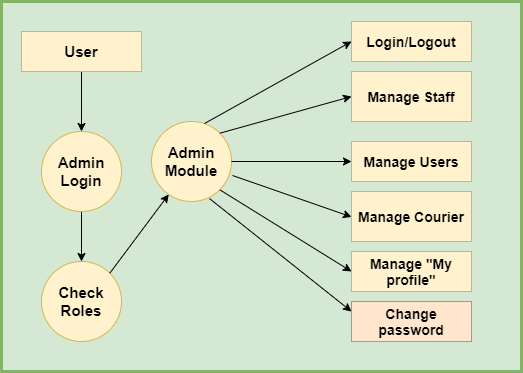
The Admin Module is used to manage the complete application.
Admin can:
- Login and logout.
- Manage courier records.
- View and manage courier bookings.
- Confirm or cancel courier bookings.
- Update courier status.
- Manage registered users.
- Add, edit, and delete staff.
- Assign courier-related tasks to staff.
- Manage payment information.
- Track courier deliveries.
- Generate or view courier-related reports where supported.
- Manage admin profile.
- Change password.
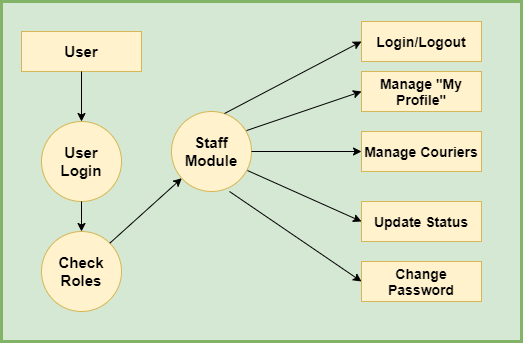
2. Staff Module
The Staff Module helps staff members manage courier pickup and delivery activities.
Staff can view information such as:
- Total couriers
- Courier pickup
- Shipped couriers
- In-transit couriers
- Couriers arrived at destination
- Couriers out for delivery
- Delivered couriers
Staff can also:
- View courier details.
- Enter courier-related information.
- View assigned courier tasks.
- Pick up couriers.
- Deliver couriers.
- Update courier status.
- Track courier progress.
- Manage their profile.
- Change password.
3. User Module
Users can register and use the courier booking portal.
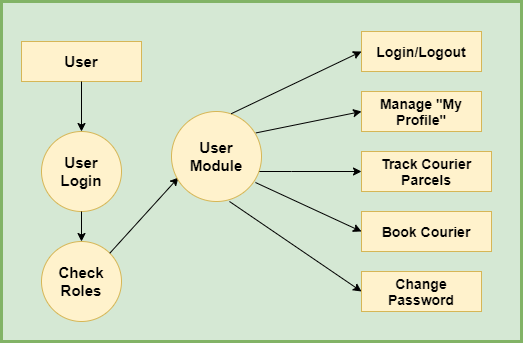
Users can:
- Register on the application.
- Login and logout.
- Manage their profile.
- Book a courier.
- View courier details.
- Add sender and recipient information.
- Enter shipping address.
- Make payments.
- Track courier status.
- View courier history.
- Contact courier staff for inquiries.
- Change password.
4. Courier Management Module
This module is used to manage courier information.
The system can maintain details such as:
- Courier reference number
- Sender details
- Recipient details
- Pickup address
- Delivery address
- Courier status
- Booking information
- Delivery information
Admin and authorized staff can update courier information according to their role.
5. Courier Booking Module
Users can book a courier through the application.
The user provides the required courier and delivery details and submits the booking request.
Admin can then view the booking and confirm or cancel it.
6. Courier Tracking Module
The tracking module allows users and staff to check the current status of a courier.
Users can enter the tracking number or reference number to find courier information.
The courier status can be updated during different stages, such as:
- Booked
- Pickup
- Shipped
- In Transit
- Arrived at Destination
- Out for Delivery
- Delivered
7. Staff Management Module
Admin can manage staff members through this module.
Admin can:
- Add staff.
- View staff details.
- Edit staff information.
- Delete staff.
- Assign courier-related tasks.
8. Payment Module
The Payment Module is used to manage payment-related information for courier bookings.
Users can make payments through the available payment functionality, while Admin can manage payment records.
If the project uses a simulated payment process, it can be used for learning and demonstration purposes.
9. Contact / Inquiry Module
Users can contact courier staff for inquiries related to their courier or delivery.
This module provides a way to submit questions or messages through the application.
CRUD Operations
The project demonstrates CRUD operations for managing database records.
- Create – Add users, staff, couriers, bookings, and other records.
- Read – View courier, user, staff, booking, and payment information.
- Update – Edit existing records and update courier status.
- Delete – Remove records when required.
CRUD operations are an important part of Java web applications and help students understand database management.
User Roles
There are three main roles in the Courier Management System.
Admin
Admin has the main control over the application.
Admin can:
- Login and logout.
- Manage couriers.
- Track couriers.
- Confirm or cancel courier bookings.
- Manage staff.
- Manage users.
- Manage payments.
- Update courier status.
- Manage profile.
- Change password.
User
Users can use the application to book and track couriers.
Users can:
- Register and login.
- Manage their profile.
- Book couriers.
- View courier details.
- Track couriers.
- Make payments.
- View courier history.
- Contact courier staff.
- Change password.
Staff
Staff members handle courier pickup and delivery activities.
Staff can:
- Login and logout.
- Manage their profile.
- View assigned couriers.
- Collect couriers.
- Deliver couriers.
- Track courier status.
- Update courier information.
- Change password.
Courier Management System – Flow
The basic workflow of the application is:
- User registers on the application.
- User logs in to the system.
- User enters courier and recipient details.
- User submits a courier booking.
- Admin receives the booking request.
- Admin confirms or cancels the booking.
- Staff receives the courier pickup/delivery task.
- Staff updates the courier status.
- User tracks the courier using the tracking/reference number.
- Staff completes the delivery.
- The courier status is updated as delivered.
- Courier and payment records are maintained in the database.
Flow Diagrams of Courier Management System
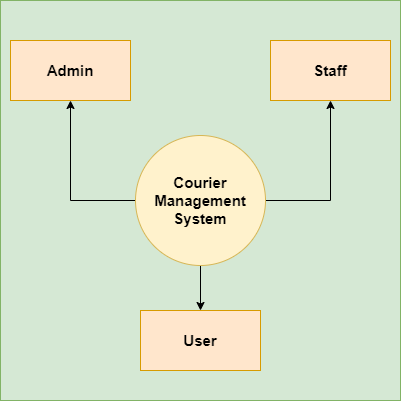
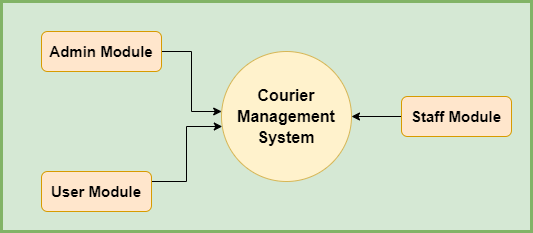
The following DFDs can help students understand the data flow and working of the project.
Level 0 DFD
Level 1 DFD
Level 2 DFD
Additional Level 2 DFD
Additional Flow Diagram
MVC Architecture
The Courier Management System follows the MVC architecture.
Model
The Model handles:
- Business logic
- Database operations
- Courier records
- User records
- Staff records
- Booking information
- Payment information
View
The View contains the user interface created using:
- JSP
- HTML
- CSS
- Bootstrap
- JavaScript
Controller
The Controller is implemented using Servlets.
Servlets handle requests from Admin, Staff, and Users and communicate with the Model to perform the required operations.
Technology Used
The project is developed using the following technologies:
- Java – Main programming language.
- JSP – Used to create dynamic web pages.
- HTML – Used for page structure.
- CSS – Used for styling.
- JavaScript – Used for client-side functionality.
- Bootstrap – Used to create a responsive interface.
- Servlet – Handles server-side requests.
- JDBC – Connects Java with MySQL.
- MySQL – Stores users, staff, courier, booking, and payment data.
- MVC Architecture – Used to organize the application.
- Apache Tomcat 8.5 – Used to deploy and run the project.
- Eclipse IDE – Can be used for development.
- Maven – Can be used to manage project dependencies.
Project Demo
Watch the project demo to understand the interface and basic working of the Courier Management System.
Free Source Code
The complete Courier Management System source code is available on GitHub.
Download Free Source Code
Courier Management System in Java – Free GitHub Source Code
Students can download the source code and configure it on their local system for learning and college project purposes.
Java Web Project Configuration Tutorial
Before running the project, you need to configure the Java web application with Java, MySQL, Apache Tomcat, and the required project dependencies.
Follow the step-by-step configuration guide:
Java Web Project Configuration Tutorial
Java Project Viva Questions
If you are preparing this project for a college viva, you can check common Java project viva questions and answers.
Java Project Viva Questions and Answers
More Java Projects with Source Code
Looking for more Java minor and major projects?
Check More Java Projects with Source Code
Conclusion
The Courier Management System Project in Java Using JSP, Servlet and MySQL is a useful Java web project for managing courier bookings, tracking, delivery, staff, users, and payment information.
The project covers important concepts such as JSP, Servlet, JDBC, MySQL, MVC architecture, CRUD operations, user roles, courier booking, courier tracking, and delivery management.
This project is suitable for final-year IT, BCA, MCA, and computer science students who want practical experience in developing a database-driven Java web application.