Online Food Donation System Project in Java using JSP and Servlet is a web-based application designed to manage food donations and connect donors with NGOs. This project is suitable for final-year IT and Computer Science students looking for a college project.
The project is available with free source code, making it useful for students who want to learn and develop a Java web application using JSP, Servlet, MySQL, JDBC, and MVC architecture.
Online Food Donation System Project in Java
The Online Food Donation System is a multi-role web application with two primary roles: Admin and User. The Admin has the main control over the system and manages users, NGOs, registrations, and food donations.
Admin can manage user and NGO registration requests, maintain NGO details, and accept or reject donation requests. Admin can also keep track of food donations made by users.
Users can register and log in to the system, manage their profiles, search for NGOs, and donate food to one or more NGOs.
The complete project is developed using Java Servlet and JSP. HTML, CSS, JavaScript, and Bootstrap are used for the front end. JDBC API is used for database connectivity, while MySQL is used as the database. The project follows the MVC (Model View Controller) design pattern.
Free Source Code of Online Food Donation System
This Online Food Donation System project is available with free source code. Students can use the source code to understand how a Java web application works with JSP, Servlet, JDBC, MySQL, and MVC architecture.
Get the Free Project Source Code:
https://github.com/jcodebun/Online-Food-Donation.git
Online Food Donation System Project Abstract
Food donation can help people who are unable to afford their daily meals. An online food donation system provides a centralized platform for managing donors, NGOs, and food donations.
Codebun has developed this Online Food Donation System in Java using JSP and Servlet with two primary roles: Admin and User. The Admin is responsible for managing the overall system, including users, NGOs, registrations, and donations.
Admin can add, update, and delete system information, manage registered users and NGOs, and view registration requests. Admin can confirm or cancel registration requests and accept or reject food donations.
Users can register on the application and donate food to one or more NGOs. They can also search for NGOs and view their details before making a donation.
Objectives of Online Food Donation System
- To provide an easy-to-use and reliable platform for managing food donations.
- To develop a secure and robust Online Food Donation System.
- To maintain records of users, NGOs, donations, donation history, and related information.
- To make it easier for users to find NGOs and donate food.
- To provide administrators with a centralized system for managing donations and registrations.
Modules of Online Food Donation System
Admin Module
The Admin Module allows the administrator to log in and manage the overall system. Admin can view, confirm, or cancel registration requests from users and NGOs.
Admin can also accept or reject food donations, manage NGO details, and maintain records of users and donations.
User Module
The User Module manages all user-related operations. Users can register by providing details such as name, contact number, and address. After registration, users can log in to the system and manage their profile.
Users can also search for NGOs and donate food through the system.
NGO Module
The NGO Module manages information related to registered NGOs. Admin can maintain NGO details and manage NGO registration requests.
Donate Module
The Donate Module allows users to donate food to NGOs. Users can select one or more NGOs from the available list and submit their donation request.
Donation Records Module
The Donation Records Module maintains information about donations made by users. Admin can view and manage donation records through this module.
User Roles of Online Food Donation System
There are two main roles in this application: Admin and User.
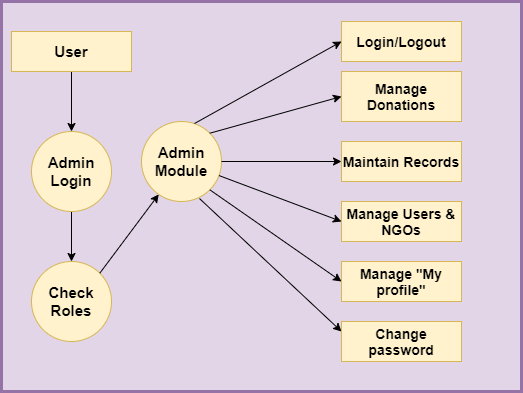
1) Admin
- Admin can log in and log out of the system.
- Admin can manage donation requests.
- Admin can manage NGOs and their details.
- Admin can manage registered users.
- Admin can view and manage registration requests.
- Admin can accept or reject donations.
- Admin can change the password.
- Admin can manage the My Profile section.
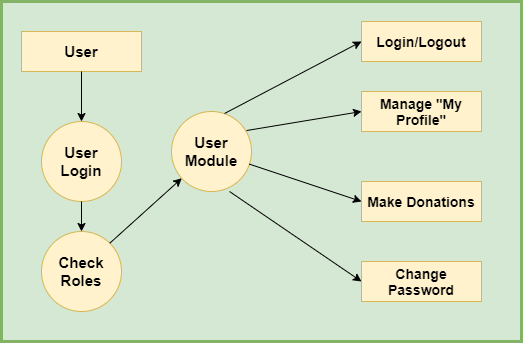
2) User
- Users can register and log in to the system.
- Users can log in and log out of the system.
- Users can manage their profile.
- Users can search for NGOs.
- Users can view NGO details.
- Users can donate food to NGOs.
- Users can change their password.
Flow Diagram of Online Food Donation System
The following diagrams represent the data flow and system processes of the Online Food Donation System.


Tools and Technologies Used
- Technology/Domain: Java
- Front End: JSP, HTML, CSS, JavaScript, Bootstrap
- Server Side: Servlet
- Database: MySQL
- Database Connectivity: JDBC
- Server: Apache Tomcat 8.5
- Architecture: MVC (Model View Controller)
Java Web Project Configuration
To run this Java web project successfully, you can follow the Java Web Project Configuration Tutorial:
https://codebun.com/java-web-project-configuration/
This tutorial provides the required configuration steps for running Java web applications using JSP, Servlet, MySQL, and Tomcat.
Free Project Source Code
The complete source code of the Online Food Donation System is available for free. Students can use the source code for learning purposes and as a reference for their college projects.
Get Free Source Code:
https://github.com/jcodebun/Online-Food-Donation.git
Project Demo
Conclusion
The Online Food Donation System Project in Java using JSP and Servlet provides a platform for managing food donations and connecting users with NGOs. It includes separate modules for Admin, Users, NGOs, donations, and donation records.
This project is suitable for final-year IT and Computer Science students who are looking for a Java web application project for their college project. It also provides practical experience with JSP, Servlet, JDBC, MySQL, Bootstrap, and MVC architecture.
Free source code is available for students to explore, understand, and use as a learning reference for their Java web projects.